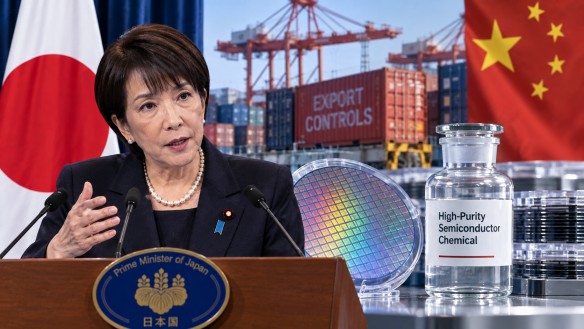
Japan has lodged a protest against China following Beijing’s announcement of new export restrictions on dichlorosilane (DCS), a chemical essential for semiconductor manufacturing. The Japanese government is currently evaluating the impact of these restrictions on its companies. The new measures mandate that Chinese importers of DCS from Japan must provide cash deposits as high as 99.2%, impacting Japanese exporters such as Shin-Etsu Chemical and Denal Silane.
The Chinese government describes these restrictions as temporary, citing an anti-dumping investigation that supposedly found Japanese DCS exports were damaging China’s domestic industry. A definitive decision will be made once this investigation concludes. Meanwhile, Japan has urged China to ensure these measures do not unjustly harm Japanese businesses and has stated it will take necessary actions if required.
This development occurs during a period of deteriorating relations between China and Japan, partly due to Japan’s stance on Taiwan. In addition to the DCS export restrictions, China has also implemented other trade and export limitations affecting Japanese companies and dual-use products, which have potential military applications.
DCS plays a critical role in the semiconductor industry, where it is used to deposit extremely thin layers of silicon and other materials on computer chips. Japan holds a significant position as a global producer of ultrapure DCS, making China’s new restrictions particularly impactful on the semiconductor supply chain.